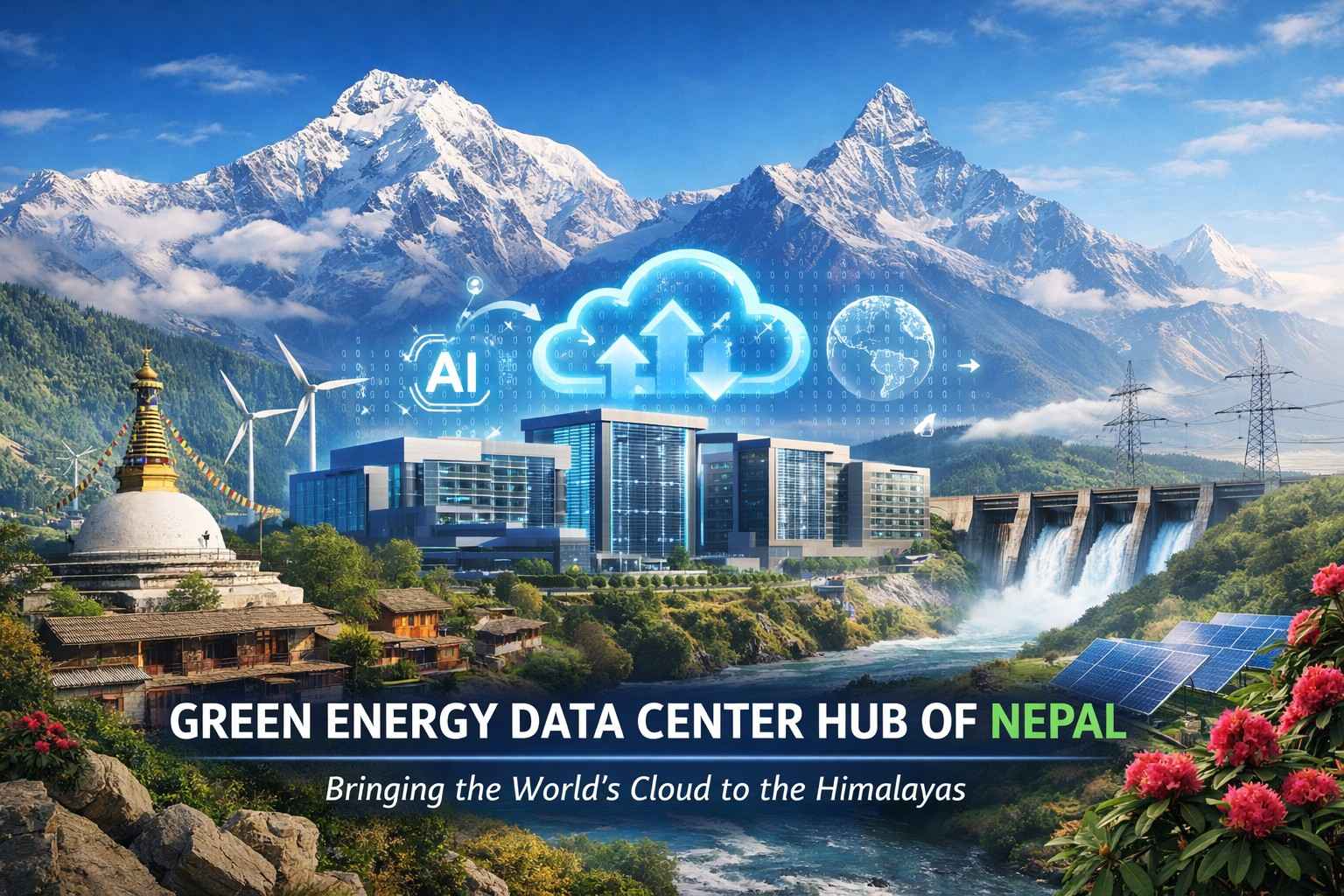
This proposal presents a transformative economic opportunity for Nepal to emerge as a global leader in sustainable data center infrastructure. By leveraging our abundant hydropower resources, naturally cool climate, and strategic geographic position, Nepal can attract billions in foreign investment without requiring direct government capital expenditure. This initiative addresses multiple national challenges simultaneously: underutilized hydropower capacity, brain drain of skilled professionals, limited ICT sector growth, and the need for economic diversification.
The global data center market, valued at USD 220 billion in 2023, is projected to reach USD 480 billion by 2030. With artificial intelligence driving unprecedented demand for computing power and sustainable infrastructure, Nepal stands uniquely positioned to capture a significant share of this expanding market.
The worldwide data center landscape is experiencing unprecedented growth, with over 8,000 facilities operating globally. This expansion is primarily fueled by artificial intelligence and machine learning applications, which consume exponentially more energy than traditional computing. A single ChatGPT query requires approximately 10 times more electricity than a standard Google search, while training large AI models consumes hundreds of megawatt-hours of electricity.
According to the International Energy Agency, AI data centers could account for up to 4.3% of global electricity consumption by 2030. Simultaneously, global data generation is projected to surge from 120 zettabytes in 2023 to over 180 zettabytes by 2025, necessitating massive infrastructure investments.
The environmental impact of current data center operations extends beyond energy consumption to water usage—a critical resource increasingly under strain. Global data centers consume an estimated 560 billion liters of water annually for cooling purposes. Google's data center network alone consumed 4.3 billion gallons of water in 2021, averaging 450,000 gallons per day per facility.
AI-related water withdrawals are projected to reach 4.2-6.6 billion cubic meters by 2027, exceeding half of the United Kingdom's total annual water withdrawal. This unsustainable trajectory is particularly problematic in regions like Silicon Valley, where water scarcity, rising electricity costs (averaging 14.5¢ per kWh), and increasing temperatures are creating operational challenges.
Major technology companies are actively seeking locations that offer clean energy, cooler climates, and reduced environmental impact. Microsoft has committed USD 50 billion between 2024 and 2026 for AI-focused infrastructure expansion, while other cloud providers are similarly investing in global capacity. Green data centers, prioritizing renewable energy and sustainability, are expected to comprise over 75% of all new builds by 2030.
Nepal possesses an estimated theoretical hydropower capacity of over 83,000 MW, with approximately 43,000 MW technically and economically feasible. Currently producing over 3,000 MW with ambitious plans to reach 10,000 MW by 2030, Nepal faces a critical challenge: limited domestic consumption capacity, particularly during monsoon seasons when production exceeds demand.
This surplus energy represents a perfect solution for energy-intensive data centers, creating domestic demand that eliminates dependency on volatile export markets and seasonal trade imbalances with neighboring countries.
Nepal's mountainous regions, particularly areas like Mustang, Manang, and Dolpa, maintain naturally cool temperatures year-round with excellent airflow. This eliminates or drastically reduces the need for water-intensive cooling systems that plague data centers in warmer climates. The natural cooling advantage translates to significant operational cost savings and environmental benefits.
Nepal's strategic South Asian location provides excellent connectivity to major Asian markets while maintaining geopolitical neutrality. This stability, combined with a peaceful international stance, makes Nepal an attractive destination for critical digital infrastructure investments.
Nepal produces approximately 3,000 IT and computing graduates annually, yet domestic market absorption remains limited at around 500 positions per year. This skilled workforce potential, currently underutilized due to brain drain, represents a valuable human resource for data center operations and ancillary services.
More than 100,000 Nepali students leave annually for higher education abroad, with significant numbers pursuing opportunities in the U.S., Canada, Australia, the UK, and Japan. In 2023-24 alone, 16,742 Nepali students enrolled in U.S. institutions, while nearly 45,000 obtained study permits for English-speaking countries—a 121% increase since 2018.
This exodus stems from limited viable career pathways in Nepal's underdeveloped ICT sector. Establishing world-class data center infrastructure would create high-paying, technology-focused employment opportunities that could retain talent domestically while attracting skilled professionals back from overseas.
Currently, Nepal faces seasonal energy trade imbalances, producing surplus electricity during monsoon periods while importing expensive power during winter months. Data centers provide consistent, year-round energy demand that optimizes hydropower utilization and creates stable revenue streams for energy producers.
The data center industry would diversify Nepal's economy beyond traditional sectors, creating opportunities in:
This initiative requires no direct capital investment from the Government of Nepal. Instead, the government's role focuses on:
Policy Framework Development:
Legal and Regulatory Reforms:
Diplomatic Engagement:
Primary targets include major cloud service providers and technology companies:
Phase 1: Foundation Building (Year 1-2)
Phase 2: Pilot Implementation (Year 2-4)
Phase 3: Scale and Expansion (Year 4-10)
Employment Generation:
Government Revenue:
Energy Sector Optimization:
Brain Drain Reversal:
Tourism and Business Development:
Innovation Ecosystem:
Infrastructure Requirements:
Regulatory and Policy Issues:
Strong Government Commitment:
International Partnerships:
Community Engagement:
The opportunity to establish Nepal as a global hub for green energy data centers represents a transformative moment for our nation's economic development. This initiative aligns perfectly with global technology trends, environmental imperatives, and Nepal's natural advantages while addressing critical domestic challenges including brain drain, energy underutilization, and economic diversification needs.
The no-cost growth model ensures that Nepal can capture the benefits of this emerging sector without straining government finances, while the focus on sustainability positions our nation as a forward-thinking leader in the global digital economy. Success in this initiative will create thousands of high-skilled jobs, generate substantial government revenue, optimize our hydropower resources, and establish Nepal as a preferred destination for international technology investments.
The window of opportunity is limited as other emerging economies recognize similar possibilities. Swift, decisive action from the highest levels of government will be essential to secure Nepal's position in this rapidly evolving market. With proper policy support, strategic international engagement, and coordinated implementation, Nepal can transform from an energy-surplus developing nation into a critical node in the global digital infrastructure network.
This initiative represents more than an economic development project—it embodies a vision of Nepal as a technologically advanced, environmentally sustainable, and economically prosperous nation that leverages its natural gifts to compete successfully in the 21st-century global economy.
The time for action is now. Nepal's digital future awaits decisive leadership.

For app inquiries or assistance, contact our customer service at provided email. Connect with us on social media or call for prompt help.